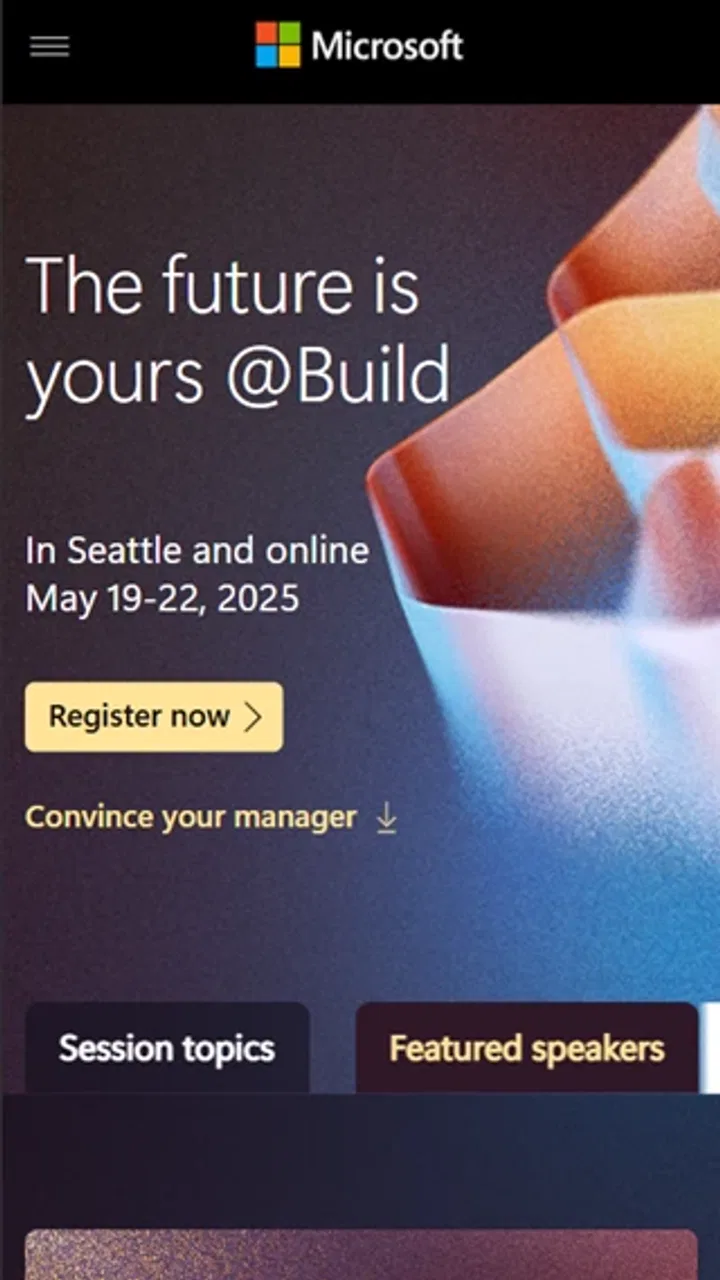
Microsoft Build
- 3.9
- Rating
- 50.00K
- Installs
- Free
- Price

 Analysis by App-foxy
I approached Microsoft Build as a companion for Microsoft’s annual developer conference, not as a general events directory. That distinction matters. The app is aimed at people who already have a reason to follow Build, whether they are developers, students, technology professionals, or simply curious about Microsoft’s announcements. My experience was most useful when I treated it as a focused event reference rather than expecting it to replace every planning, note-taking, or communication tool I already use.
It is a free Events app from Microsoft Corporation, with an Everyone content rating and support beginning at Android 4.4. The release is listed as September 22, 2024, and the current version is 1.0.0.3. Those details make it approachable for people using older Android hardware, although the quality of the experience will still depend on the phone’s screen, performance, and operating-system behavior.
The app has reached over 50 thousand installs and holds a 3.9 average from more than 275 ratings. I read that as a sign of moderate interest rather than universal approval. It is established enough to attract a real audience, but the rating also suggests that expectations should remain practical. This is a specialized conference app, and its value depends heavily on whether you need information about Microsoft Build at the time you open it.
You May Also Like

 Blood Strike: 2.5 Anniversary
Blood Strike’s Loadouts Turn Every Drop Into a Tactical Gamble
A close look at Blood Strike’s custom loadouts: how fast access to signature weapons reshapes its battle royale rhythm, rewards preparation, and narrows the gap between fights.

 Pandora - Music & Podcasts
Pandora’s Music Is Easy to Start, but Harder to Recover
Pandora’s strength is its low-effort path from a seed to a station. Its weak spot is how much confidence it asks you to place in connection, setup, and quiet recovery.

 8 Ball Pool
 Is Built on Rivalries, Rematches, and Routine
A close look at the rivalries, rematches, shared routines, and unanswered safety questions that turn a quick pool match into a persistent mobile community.

 Samsung Music
’s Quiet Strength Is Playing What You Already Own
Its reach comes less from spectacle than from dependable access to a personal library. That simplicity is both the app’s strongest retention engine and its ceiling.

 AccuWeather: Weather Radar
AccuWeather Review: A Quick, Clear Forecast for Everyday Decisions
For everyday plans, the best forecast is the one you can understand quickly. AccuWeather makes rain timing, radar, and local conditions easy to act on, with a few trade-offs.

 Hill Climb Racing
Why Hill Climb Racing Still Turns Crashes Into One More Run
A tiny car, a bumpy hill and one more upgrade: Hill Climb Racing keeps resurfacing because its simple chaos makes every near-miss feel personal.
More From Our News Desk



How clearly the conference information can be read and navigated
The first thing I noticed about a conference companion is that clarity matters more than visual excitement. Event apps can become frustrating when they place too much information on one screen or make the user repeatedly return to a crowded landing page. For Microsoft Build, I found it helpful to approach each screen with a specific task in mind: checking what the conference is about, locating relevant information, or preparing for a session-focused day.
That task-based approach is especially useful for readers who do not want to explore every section. A developer looking for material related to a particular area can move through the app with a narrower purpose than someone casually browsing the event. I recommend deciding what you want before opening it. For example, you might be checking whether the conference is worth following, preparing a short list of topics, or reviewing information immediately before an event activity. A clear goal reduces the feeling of wandering through conference content.
Text-heavy event information can be easier to manage than a fast-moving social feed because you can pause and read at your own pace. That is a meaningful advantage for people who need more time to process technical language or who prefer to compare details slowly. It also makes the app more suitable for someone using a smaller phone, where dense layouts can otherwise become tiring.
Still, readability is not only about font size. Conference material often includes unfamiliar product names, technical terms, and compact descriptions. I found that the app works best when I avoid trying to absorb everything in one sitting. Reading a small portion, mentally grouping related topics, and returning later is a better workflow than treating the application like a complete reference manual.
One useful habit is to use the app before the conference rather than waiting until the busiest moment. When a person is already tired, distracted, or moving between places, even a simple navigation decision can feel difficult. Reviewing the available information in a quiet setting gives you time to identify the sections that matter and remember where to return later.
The app’s focused identity is also a navigation benefit. Unlike a broad events service that may mix concerts, trade shows, local gatherings, and unrelated recommendations, this one is centered on Microsoft Build. That narrower scope can make the experience less noisy for its intended audience. The trade-off is obvious: if you are searching for other technology conferences or general event planning, this is the wrong place to begin.
Reading comfortably on different screens
I would pay particular attention to screen comfort if I were using a compact phone or an older device. Technical event information is rarely enjoyable when the user must constantly zoom, scroll sideways, or hold the phone at an awkward angle. The app’s support for Android 4.4 broadens device compatibility, but compatibility should not be confused with an identical experience on every handset.
People with low vision may prefer to adjust the phone’s system text or display settings, where available, and then check whether the app remains comfortable to use. That is a sensible test before relying on it for an entire event. Enlarged system text can improve legibility in some applications, while in others it can cause lines, buttons, or descriptions to become cramped. I would not assume that a setting that works perfectly elsewhere will behave the same way here.
For readers who process information more easily in short sections, I suggest making a personal shortlist outside the app as you go. A brief note containing the topics you care about can reduce repeated reading and make the app less demanding later. This is not a replacement for the app; it is a way to turn its conference information into something easier to scan under pressure.
Navigation for people who use different input methods
Motor access deserves attention because event apps are often used while standing, walking, carrying a bag, or holding another object. Small touch targets and repeated scrolling can become more difficult in those situations, even for users without a permanent motor limitation. I found that the most comfortable approach is to do the detailed browsing while seated and reserve quick checks for moments when I am already familiar with the information.
Someone who uses a stylus, switch access, voice control, or another alternative input method should test the main navigation before depending on the app. The critical question is not whether the app opens, but whether the important controls can be reached in a predictable order and activated without precise tapping. A conference companion is only genuinely useful if a person can reach the information they need without repeated trial and error.
There is also a practical trade-off between keeping the app open and moving between it and another tool. If you need to copy information into notes, compare it with a calendar, or communicate with a colleague, repeated app switching may add effort. I would prepare the most important points in advance instead of assuming that the app alone will handle every planning task.
How well it fits sensory needs and changing situations
People do not use event apps in ideal conditions all the time. You may check Microsoft Build in a quiet room, on public transport, in a bright hallway, or while surrounded by other people. Those contexts change how easy it is to read, concentrate, and remember what you have just seen.
For users who are sensitive to visual clutter, the app is easier to approach when used selectively. I would avoid opening it with the intention of exploring every available detail. Instead, focus on one topic or one planning question, then stop. This reduces the amount of visual information competing for attention and makes the experience feel more manageable.
People with attention-related needs may benefit from a simple routine: open the app, identify the relevant section, read only the information connected to the current task, and record the next action. For example, if you are deciding whether a conference topic is relevant to your work, you do not need to investigate every other area at the same time. That workflow is a small but important improvement over unstructured browsing.
Users with hearing-related needs should be careful about relying on an event app as their sole source of situational awareness. An app can provide conference information, but it does not automatically solve every communication or live-event barrier. If an important announcement, instruction, or change is delivered through another channel, you may need an additional way to follow it. I would therefore treat Microsoft Build as one part of an access plan, not the complete plan.
People who are sensitive to motion, rapid changes, or bright displays may prefer to use the app in a stable environment with the phone’s display configured for comfort. Lowering brightness, increasing contrast through system settings where appropriate, and taking breaks are reasonable habits. These adjustments are especially useful when reading technical content for a long period, because mental fatigue can arrive before the user notices it.
One realistic scenario is a developer preparing for a busy conference day from home. I would open the app in advance, review the information relevant to my work, write down the few items I genuinely want to follow, and then stop browsing. Later, while commuting or waiting between activities, I could return for a quick reminder instead of trying to make decisions on a crowded platform. That division between preparation and quick reference makes the app more accessible than using it as an all-day information stream.
Where it is more useful than ordinary alternatives
A web browser is the obvious alternative, and it may be better for people who need a larger display, browser-based text tools, or easier copying between tabs. On a computer, technical information can be compared more comfortably, especially for users who depend on a large monitor, keyboard navigation, magnification, or specialized reading software. I would choose the browser for deep research and the app for a more focused mobile check.
A general calendar app is better for personal scheduling. It can hold appointments, reminders, travel plans, and unrelated commitments in one place. Microsoft Build is more useful for conference context, while a calendar is more useful for remembering what you personally decided to do. Keeping those roles separate prevents disappointment. I would not expect this app to become my complete daily organizer.
Notes applications also have an advantage when the goal is to create a customized, accessible summary. A note can use your preferred headings, spacing, language, and level of detail. Microsoft Build is valuable for consulting the event itself, but notes are better for turning that information into a personal checklist that can be read quickly later.
For someone who needs broad event discovery, a general events platform is the stronger choice because it covers many organizers and subjects. The focused design of Microsoft Build is a strength only when Microsoft’s developer conference is the event you actually want. This is an important boundary: I would recommend it to a person following Build, but not to someone simply looking for local activities or a universal conference manager.
Practical barriers that can still affect access
The biggest limitation is specialization. If you are not interested in Microsoft’s developer conference, the app has little reason to remain installed. Even a well-organized companion becomes unnecessary once your event-related task is finished. That makes it a purposeful download rather than a general-purpose utility.
Another barrier is the difference between having information available and being able to use it under pressure. A person may be able to read the app at home but struggle in a noisy, bright, crowded, or hurried environment. I would plan around that by reviewing important material early and keeping a short personal summary. This is particularly helpful for users who need extra processing time or who find rapid context changes exhausting.
Older Android support is welcome, but older hardware can still introduce friction through slower loading, smaller displays, reduced battery life, or less comfortable touch response. I would test the app on the actual phone I intend to carry, not just assume that the minimum operating-system requirement guarantees a smooth experience.
The app also should not be treated as a substitute for personal accommodations, assistive technology, or direct communication when those are needed. Its role is to provide a mobile way to engage with Microsoft Build. If your participation depends on captioning, interpretation, alternative formats, human assistance, or a particular navigation method, make those arrangements separately rather than expecting the app to cover every need.
Privacy-conscious users may also prefer to keep their use narrowly focused. Since this is a conference companion rather than a general social platform, I would avoid granting it a larger role in my digital routine than necessary. Install it when the event is relevant, use it for preparation and reference, and reassess whether it still serves a purpose afterward.
Who should use it and who should choose something else
I would recommend Microsoft Build to developers and technology learners who want a dedicated mobile point of reference for the conference. It is also a reasonable choice for professionals who need to check event information away from a desk, particularly if they prefer an app over repeatedly searching through a browser.
It may suit people who like focused tools. Because it is tied to one Microsoft event, it avoids the broad, distracting scope of a general events directory. That can help a user who already knows what they are looking for and wants to stay within that subject.
I would skip it if you need a universal event planner, a complete personal calendar, a local event discovery service, or a dedicated accessibility tool. In those cases, a browser, calendar, notes app, or specialized assistive solution will likely serve you better. I would also skip it if you are downloading it only because it is free; its usefulness depends on a genuine interest in Microsoft Build.
The free price removes a financial barrier, and the Everyone rating makes it broadly approachable from an age-classification perspective. Those are practical advantages, especially for students or first-time attendees who want to explore the conference without paying for the companion itself. They do not, however, guarantee that the content or navigation will match every person’s reading, motor, sensory, or communication needs.
My inclusive verdict after using it as a focused conference companion
Microsoft Build is a specialized Events app with a clear purpose: helping people engage with Microsoft’s annual developer conference from a mobile device. I found its strongest quality in that focus. It is easier to understand when used as a conference reference than when judged against calendars, browsers, note tools, or general event platforms.
Its accessibility value is practical rather than absolute. Support for Android 4.4 helps people with older phones, and the focused subject can reduce unnecessary browsing. At the same time, users with different visual, motor, hearing, attention, or processing needs should test the actual navigation and prepare backup workflows before relying on it in a demanding setting.
My best tip is to use it in two stages: first for calm preparation, then for short checks when you need a reminder. Pair it with system display settings, personal notes, and whatever communication or assistive tools you already depend on. That approach makes the app more useful without asking it to perform jobs it was not designed to do.
Overall, I see it as a sensible free download for people who specifically follow Microsoft Build and want conference information close at hand. The 3.9 average reflects a product that is useful for its intended audience but not universally compelling. Choose it for focused Microsoft Build access, not as a replacement for your calendar, browser, or accessibility setup.
For me, that is the fairest recommendation: install it when the conference is part of your plans, explore it before you are under time pressure, and keep a personal alternative ready for any information or access need the app does not cover.
FAQs for Microsoft Build
01What is Microsoft Build and what does it offer?
Microsoft Build is a comprehensive app designed for developers, offering a wealth of resources including live coding sessions, tutorials, and networking opportunities. It provides tools for creating applications across various platforms, including Windows, Azure, and Microsoft 365. Users can explore the latest in AI, machine learning, and cloud technologies.
02Is Microsoft Build suitable for beginners in programming?
Yes, Microsoft Build caters to both beginners and experienced developers. It features a range of tutorials and sessions tailored to different skill levels. Beginners can find introductory materials and step-by-step guides, while advanced users can delve into more complex topics and cutting-edge technologies.
03Can I access Microsoft Build content offline?
While Microsoft Build primarily functions online to provide live updates and interactions, some content, such as recorded sessions and documentation, may be available for offline access. Users should check specific sections of the app or website for downloadable materials that can be viewed without an internet connection.
04How does Microsoft Build support developers working on cross-platform applications?
Microsoft Build supports developers with cross-platform tools and resources, enabling them to create applications that work seamlessly across Windows, Android, and iOS. The app offers guidance on using frameworks like Xamarin and .NET MAUI, and provides integration tips for ensuring consistent performance across devices.
05Are there networking opportunities available through Microsoft Build?
Yes, Microsoft Build offers numerous networking opportunities for developers. Users can connect via live chat sessions, discussion forums, and virtual meetups. These platforms allow developers to share insights, collaborate on projects, and gain feedback from both peers and industry experts.
Pros
- Highly intuitive and user-friendly interface.
- Wide range of integrated developer tools.
- Regular updates with new features.
- Strong community support and resources.
- Cross-platform compatibility for versatility.
Cons
- Resource-intensive
- needs high-performance devices.
- Limited offline functionality for some features.
- Steep learning curve for beginners.
- Some tools require paid subscriptions.
- Occasional bugs reported post updates.

Microsoft Build
Gallery